

Ontario Disability Support Program
Find information about income support, benefits for health costs and other disability supports from the Ontario Disability Support Program (ODSP).
ODSP rates are now tied to inflation
Certain ODSP rates are now tied to inflation. In any year that payments go up, you will receive the higher payment at the end of July of each year.
This annual increase applies to:
- basic needs and shelter maximum amounts for singles and families
- board and lodge amounts for singles and families
- the amount provided for a couple where both have disabilities
- amounts for services provided by a Long-Term Care Home or a Specialized Care Residence
In July 2023, ODSP rates increased by 6.5%. This latest increase is in addition to the 5% increase applied in September 2022, bringing the total to almost 12% over 12 months.
Overview
ODSP offers:
- money to help you and your eligible family members with living expenses, including food, and rent
- health benefits, including prescription drugs and vision care
- employment support to help you find and keep a job or advance your career
If you are eligible for ODSP, the amount of money you get will depend on your specific situation.
You could receive up to $1,308 a month for basic needs and shelter if you are single.
You may receive more than this for:
- benefits (for example, you might get additional money for transportation to medical appointments)
- other immediate family members (for example, if you have a spouse or child you will receive a larger amount)
The amount you get will depend on your specific situation.
Learn about income support, benefits for health costs and other disability supports from ODSP.
Eligibility
Learn about the financial and medical information we use to determine if you are eligible for the Ontario Disability Support Program (ODSP), and what information you need to provide.
Income support available
Find information about income support available to you if you are a recipient in the Ontario Disability Support Program (ODSP).
Rights and responsibilities
Learn about the rights and responsibilities you and your family have when you apply for or receive support from the Ontario Disability Support Program (ODSP).
Working and earning
Learn about the benefits of working and earning when you are on the Ontario Disability Support Program (ODSP) and how it affects your income support. Find out how to report the money you and your family earn.
Health Care Professionals
If you are a health care professional, you can find information about completing the following for your patients
How to apply for ODSP
You can apply for ODSP:
- online: Follow the steps below to apply for ODSP online. The application takes 20 to 30 minutes. Submit one application for you and your immediate family members who live with you.
- over the phone by contacting the Social Assistance Contact Centre
Toll-free: 1-888-999-1142 orToll-free TTY: 1-800-387-5559 . - in-person by booking an appointment through your local ODSP office.
The application process may take a few months.
If you do not have enough money to support yourself and your family while we review your application, you can apply to Ontario Works and ODSP at the same time online.
Your eligibility for Ontario Works will be assessed first, and if you are eligible, you can receive financial assistance from Ontario Works while we assess your application for ODSP.
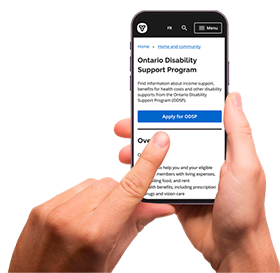
Apply online
If you need support with money for food and housing and/or if you have a disability and are in financial need, you can apply for Ontario Works or the Ontario Disability Support Program through one simple application.
Follow these steps to apply for ODSP online. In most cases, it takes 20 to 30 minutes.
Submit one application for you and your immediate family members who live with you.
Before you start
Make sure that all family members included in your application are with you when you apply online so they can provide their consent and confirm their information.
Have your family’s identification and documents ready, such as:
- social insurance numbers (SIN)
- OHIP cards
- birth certificates
- immigration papers
- tax returns
- banking information
Technical requirements to apply online
To complete the application online, you will need the latest version of one of these web browsers:
Step 1: fill in your personal information
You will be asked to fill out your family’s:
- full legal names, dates of birth and status in Canada
- address
- email addresses (for all family members 18 and over)
- total monthly income and available assets
- housing costs
- other expenses (such as child care and disability related expenses)
- your bank account information (if you have one) so you can get your payment quickly
Once complete, submit your application.
Step 2: ODSP reviews your application
A caseworker from your local ODSP office will review your application and will call you within 15 business days to schedule an appointment.
Step 3: meet with the ODSP office to sign and verify your application
Meet with an intake caseworker for your verification appointment.
The caseworker will ask you to provide more information, like copies of bills or other documents, so we can verify the information you included in your application. This could include:
- proof of any income or employment
- shelter costs and proof of residency in Ontario
- bank statements covering a minimum of one month prior to the application date
- Depending on circumstances, up to 12 months may be required.
- To avoid potential delays, please come prepared with any additional statements available to you from your financial institution at no additional cost.
- If you use online banking, most financial institutions provide access to free electronic statements for several years.
- information on any other assets you may have, such as stocks, bonds or investments
You may also be asked to sign your application package if you have not signed it electronically, including a consent form to allow ODSP to access information about you from other government programs or organizations (for example, the Ministry of Transportation, Employment Insurance, Equifax Canada). This information will help to determine if you qualify for assistance.
If no additional information is required, the caseworker will let you know if you are financially eligible for ODSP within 15 business days.
If ODSP determines that you are not financially eligible for ODSP, you will have 30 days to request that ODSP review your information again.
Step 4: submit a Disability Determination Package
If you are a member of a prescribed class, you do not have to complete this step.
If you are financially eligible for ODSP, you will receive a paper Disability Determination Package (DDP).
This package must be completed by an approved health care professional, such as your family doctor, a registered nurse, a nurse practitioner or a psychologist.
Your health care professional may complete either the paper DDP or the digital DDP.
If your health care professional completes the paper DDP you can mail it to the Disability Adjudication Unit using the addressed envelope that comes with the package.
The disability determination package includes:
- Instruction sheet on how and who can complete the forms
- Health Status Report that asks for information about your medical condition (for example, impairments, restrictions, treatments, duration)
- Activities of Daily Living Index that asks for information about how your medical condition affects your daily life, including your ability to work, care for yourself and participate in your community
- Self Report that gives you the opportunity to tell us about how your disability affects your daily life
- Consent to the Release of Medical Information for you to complete and sign
If your health care professional completes the digital DDP, you may provide your completed and signed Consent and Self Report forms for them to send to the Disability Adjudication Unit digitally.
You and your health care professional should also submit additional medical and supporting information (for example, clinical notes, hospital reports, psychological or functional assessments). This information will help us make an informed decision.
Step 5: ODSP reviews your disability determination package
Specialized ministry staff (including doctors, nurses or occupational therapists) review your completed disability determination package to determine if you meet the legislative definition of a person with a disability.
You will receive a letter from the Disability Adjudication Unit within 90 business days to let you know if your disability qualified.
Step 6: develop a plan
If you are eligible, your caseworker will contact you to schedule an appointment to develop a plan for how best to help you and let you know when you can expect your first payment.
Check the status of your application
If you applied online
You can check the status of your application after you submit it online. This digital feature is available to most applicants.
To check the status of your online application, you will need your application number.
Your application number is in the email we sent you if you submitted your application online. It is also displayed on the confirmation page after you submit your application.
Check the status of your online application
If you applied in person or by phone
You can find out the status of your application by calling us Monday to Friday between 8:30 a.m. and 5:00 p.m. (ET):
Sign in to MyBenefits
Continue an application, report changes or get information about your Ontario Works or Ontario Disability Support Program case.
Returning to ODSP
If you left ODSP but need to come back for financial help, you may be eligible for rapid reinstatement.
Rapid reinstatement makes it faster and easier for you to start receiving ODSP again without having to go through a disability assessment.
To find out if you are eligible for rapid reinstatement please contact your local ODSP office.
Employment supports
If you are a person with a disability and interested in working, you can get help finding a job. Many supports are available to help remove disability-related barriers to employment.
You may ask ODSP staff for more information about how to access employment supports in your community.
Learn more about employment supports.
ODSP forms
If you are applying to ODSP or are receiving income support through the program, your ODSP caseworker may ask you to submit one or more of the following forms found on the Central Forms Repository (CFR):
- Application for Employment Supports
- Business Assets Review
- Business Income and Expenses Report
- Business Profile
- Employment/Training Income Report
- ODSP Hearing Aid Benefit (Exceptional Circumstances)
- Request for Internal Review
- Rights and Responsibilities Ontario Disability Support Program
- Vehicle Trip Log
- Verification of Disability/Impairment
- Welcome to ODSP Employment Supports
ODSP payment dates
ODSP issues income support payments monthly.
Payments are on the last business day of each month. December payments may be available earlier in the month.
| Benefit month | Payment date |
|---|---|
| December 2023 | December 20, 2023 |
| January 2024 | January 31, 2024 |
| February 2024 | February 29, 2024 |
| March 2024 | March 28, 2024 |
| April 2024 | April 30, 2024 |
| May 2024 | May 31, 2024 |
| June 2024 | June 28, 2024 |
| July 2024 | July 31, 2024 |
| August 2024 | August 30, 2024 |
| September 2024 | September 27, 2024 |
| October 2024 | October 31, 2024 |
| November 2024 | November 29, 2024 |
| December 2024 | TBD |
ODSP office locations
Use the social assistance office locator to get contact information for your local office.
Policy directives
You can read the policy directives that provide the requirements and guidance for the administration of: